The storm that takes a tree down in San Diego rarely brings rain. It is the Santa Ana wind: a dry offshore flow that drops humidity into single digits and runs forty to seventy miles an hour across a canopy that has been drying out since May. Nothing softens the branches first, so what fails is whatever had already stopped being sound. This is what to look at, and what actually holds a tree together.
Most of the country loses trees to weight: snow or ice lands on a leafed-out crown and the branch union is asked to carry several times what it was built for. San Diego loses trees to load in a different way. The Santa Ana arrives dry, so nothing is added to the crown and nothing is reduced by it either. What the wind does is apply lateral force to a tree that is already carrying deadwood, a cracked union or a root plate that shrank away from the soil during a dry summer. The gust is the trigger, not the cause.
That is why the calls cluster on the first strong event of the season. A tree that has been standing through a calm, dry autumn has had no test. The first night the wind comes off the mountains, the accumulated defects get one.
Eucalyptus is the species that fills the schedule. It grows fast, it holds dead limbs inside a live crown for years, and the wood is heavy. A eucalyptus limb that has been dead for two seasons can be thirty feet long and still attached, and it drops without warning. Coast live oak fails differently: the limbs are long and horizontal, so a gust lands on a lever arm, and an old oak with included bark between co-dominant stems opens at the union.
Palms are their own category. A Canary Island date palm that has lost its crown to the South American palm weevil is a dead column with a heavy head, and it can be standing perfectly upright the day before it comes over. A fan palm sheds fronds in wind, which is nuisance rather than injury, but a dead skirt of fronds is a fire ladder in a wind-driven fire.
A tree that has been irrigated on a shrinking schedule, or that sits on clay that swells and shrinks with the seasons, develops a root plate that no longer fits the hole it grew in. The soil pulls away and the roots lose the lateral support that holds a lean. The visible sign is a crack in the soil on the windward side of the trunk, or soil lifted on the leeward side.
On a canyon lot this matters more than on a flat one. The tree on the rim of a canyon is rooted in thin soil over sandstone, and the failure mode is the whole plate rotating out of the slope rather than a limb breaking.
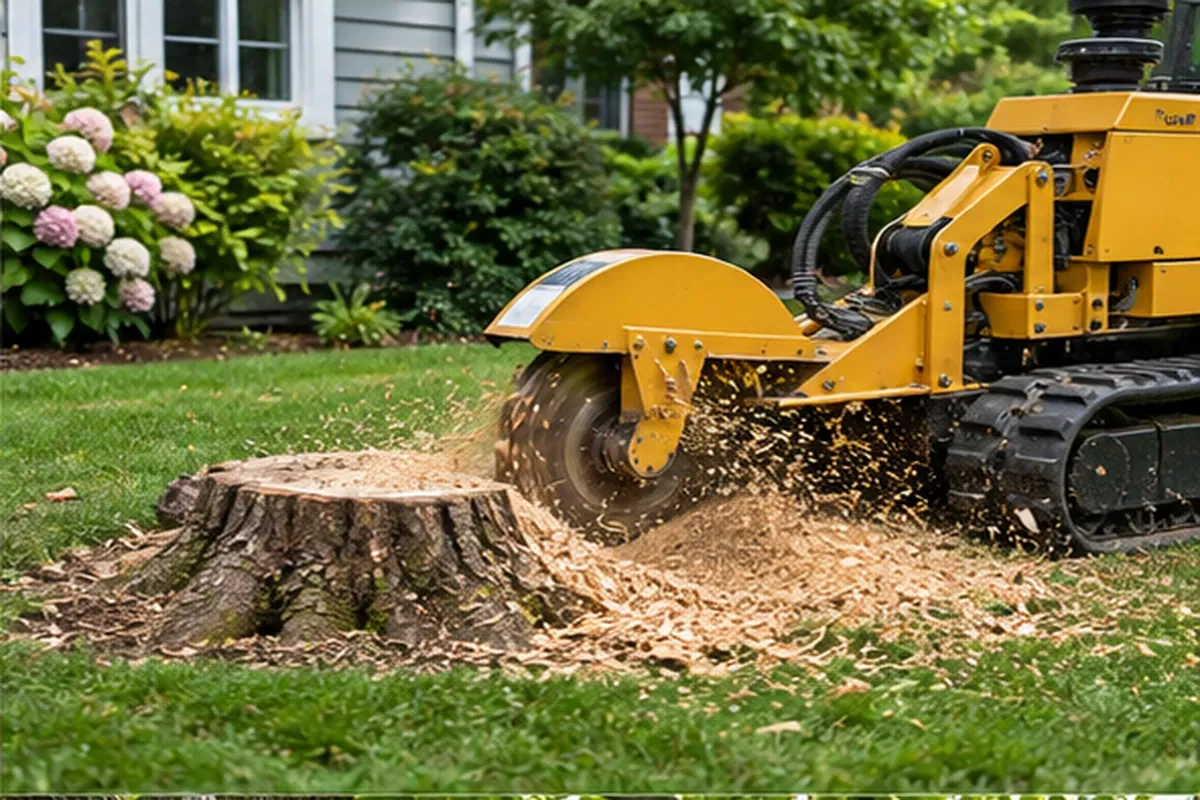
Published 2026 national ranges put a typical removal at $400 to $1,200, with an average around $850. Banded by height: under 30 feet $200 to $500, 30 to 60 feet $500 to $1,500, 60 to 80 feet $850 to $2,000, and over 80 feet $1,200 to $2,500 or more. Removing deadwood from a standing tree instead is published at $400 to $900 per tree, and stump grinding at $100 to $500 or more per stump.
Two things push a San Diego job above the band: canyon access, where the debris has to come up a slope rather than down a driveway, and a palm, where the removal is a climb and a controlled lowering of a heavy head rather than a felling.
Almost every failure in a wind event was decided years earlier: deadwood never removed, a co-dominant stem never reduced, a crown that grew long and horizontal over a roof. Deadwood removal on a mature eucalyptus is an afternoon of climbing and chipping, and it removes the material that becomes the projectile.
If a cable or a brace is proposed on a weak union, ask what it is holding, what the inspection interval is, and who inspects it. A cable holds a union together; it does not make a dying tree safe, and it does not fix a root plate that has already moved.
Because the defect was already there. A Santa Ana wind is dry, so nothing is added to the crown; the wind simply applies force to deadwood, a cracked union or a root plate that has lost its soil. The calm month before it is what makes the first strong gust look like the cause.
Published ranges put deadwood removal at $400 to $900 per tree and a typical removal at $400 to $1,200. Emergency or after-hours work prices above the standard band, and canyon access adds a premium because the debris has to be carried out rather than dragged.
A cable is a support for a union that is otherwise sound, not a repair for a tree that has already split. If the split runs into the trunk, or the root plate has moved, removal is the answer. Ask what the cable is holding and how often it will be inspected before agreeing to one.